Radxa Cubie A5E Case — Screwless Snap-Fit, Parametric (OpenSCAD)
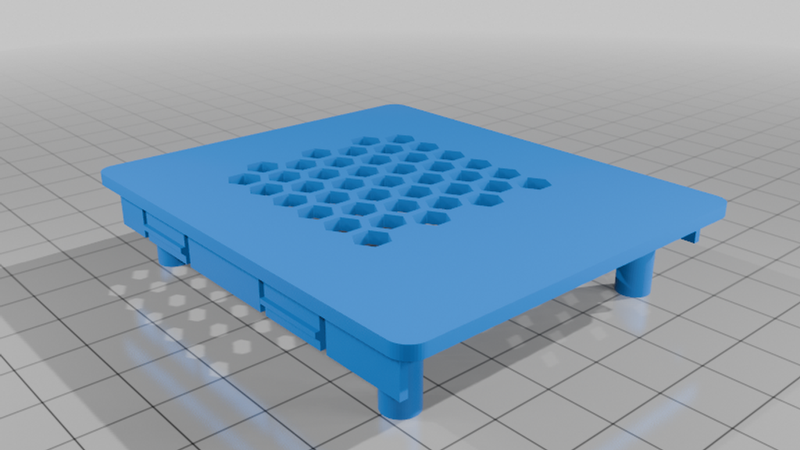
Description
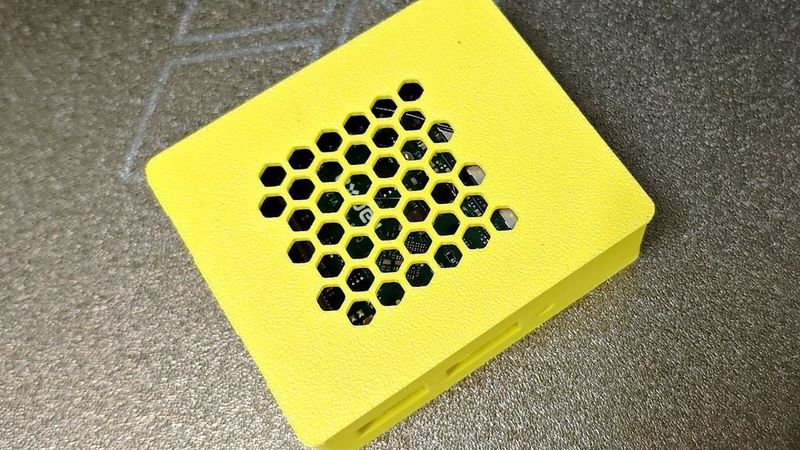
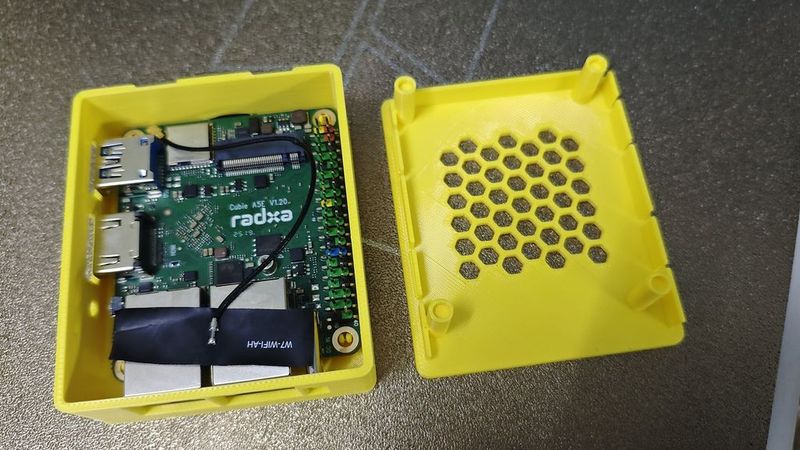
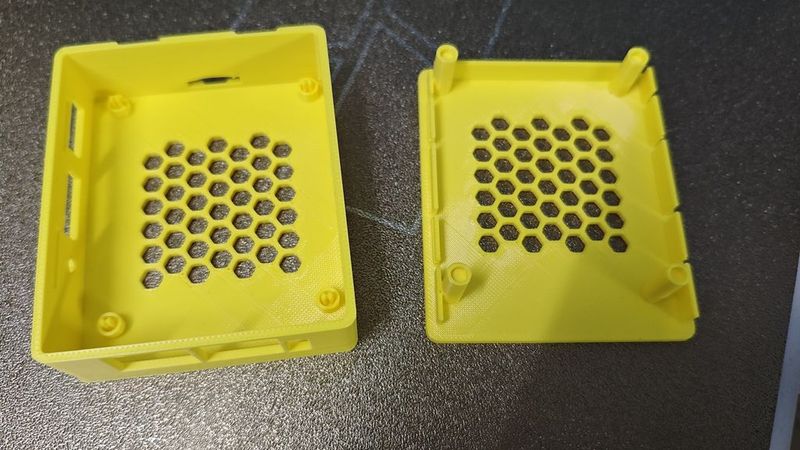
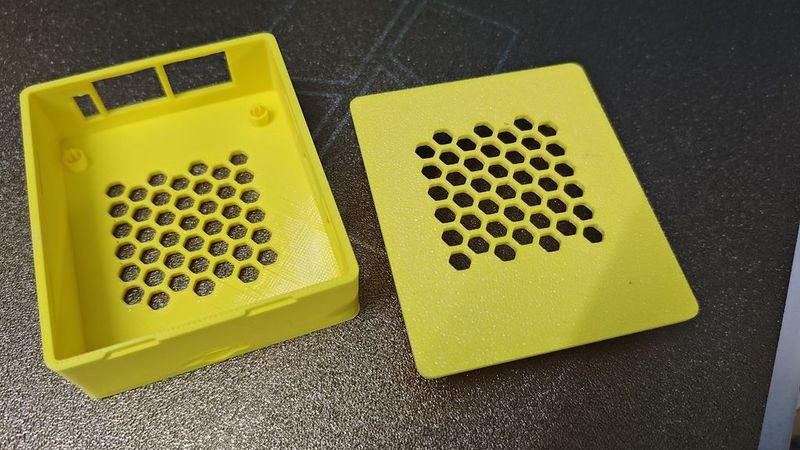
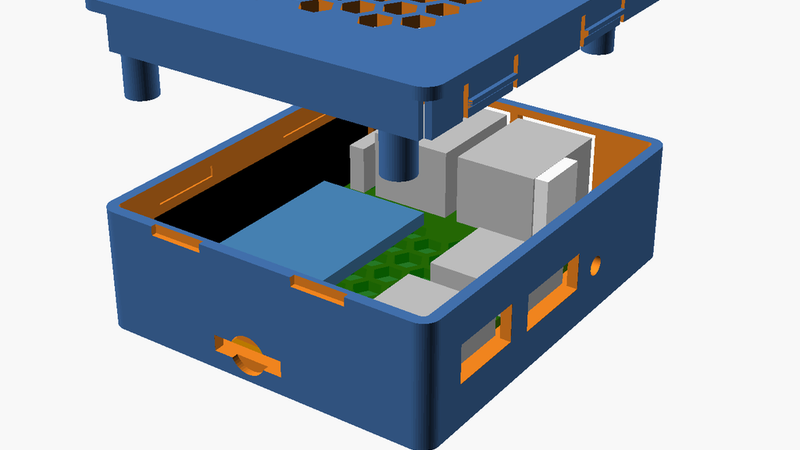
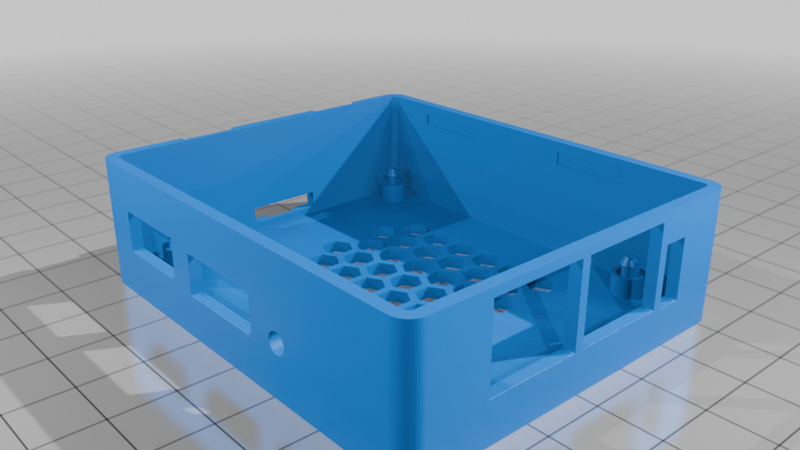
A two-piece printable enclosure for the Radxa Cubie A5E single-board computer. No screws, no heat-set inserts, no hardware of any kind, and no support material in either orientation. Print two parts, click the board in, click the lid on.
The whole design is parametric OpenSCAD and the `.scad` source is included in the downloads — if the stock case is not what you want, you change a number at the top of the file and re-export.
Printed and verified on a Bambu A1 in Numakers PLA Pro (yellow) at 0.2 mm with 3 perimeters. The photos are that print, straight off the plate with no finishing.
Every dimension came out of Radxa's own CAD model
Not from photographs, and not from datasheet numbers. Radxa's official STEP file (`radxa_cubie_a5e_pcba_3d_v1.2.stp`) is a 46 MB B-Rep assembly in which every solid is an unnamed compound. It was imported through OpenCASCADE, which resolved it into 316 solids, and each solid's bounding box and planar faces were read straight out of the kernel. Connectors were then identified by matching face geometry against connector standards, rather than by guessing from position on the board.
Three things fall out of that which cases designed from photos get wrong:
* The USB-C is mounted vertically. A horizontal 8.94 × 3.26 mm cut-out will not admit a plug. The opening has to be 3.16 wide × 8.96 tall.
* The microSD socket is on the underside. It opens at the rear edge and hangs 1.43 mm below the PCB, so the slot sits below the board plane and the floor has to be standoff-mounted.
* The board is 65 mm, not 69. Several listings quote 69 × 56 mm. The CAD outline is unambiguously 56.04 × 65.00 mm — the 69 figure is measured over the Ethernet jacks.
Specifications
| | |
|---|---|
| Outer size | 64.45 × 75.60 × 24.10 mm |
| Wall / floor / lid | 2.0 mm each |
| Fasteners | none |
| Supports | none |
| Filament | ~22 g tray, ~14 g lid |
| Licence | CC BY 4.0 |
Ports
Every opening is sized to the connector's outer face — the plane the plug actually passes through — rather than to its bounding box. That is what keeps a usable 1.64 mm rib standing between the two Ethernet jacks.
| Port | Wall | Opening |
|---|---|---|
| RJ45 Gigabit Ethernet ×2 | front | 15.47 × 12.84 mm each |
| USB 2.0 Type-C (power in) | front | 3.16 × 8.96 mm, vertical |
| HDMI Type-A | left | 15.00 × 5.55 mm |
| USB 3.0 Type-A | left | 13.10 × 5.72 mm |
| UBOOT / FEL button | left | Ø3.5 mm paper-clip access |
| microSD | rear | slot + Ø7 mm thumb scallop, below the PCB plane |
| SMA antenna | rear | Ø6.5 mm, off by default |
| 40-pin GPIO | lid | optional slot, off by default |
Assembly — no tools
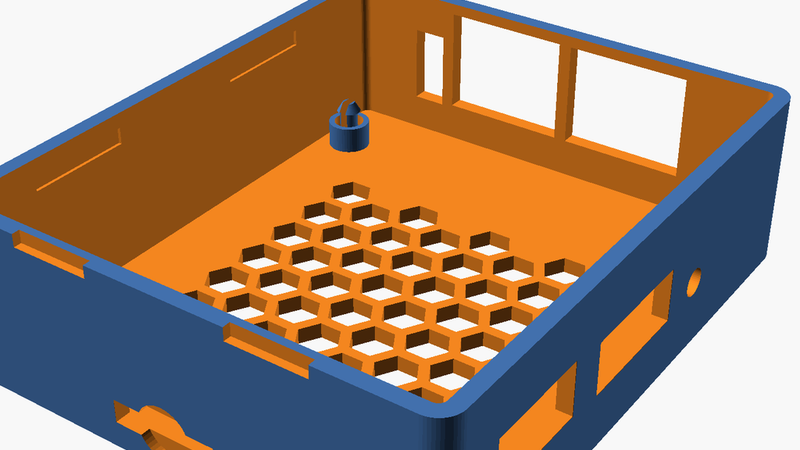
1. Press the PCB down onto the four tray pegs until the barbs click over the top face. Start at one corner and work round; do not push all four at once.
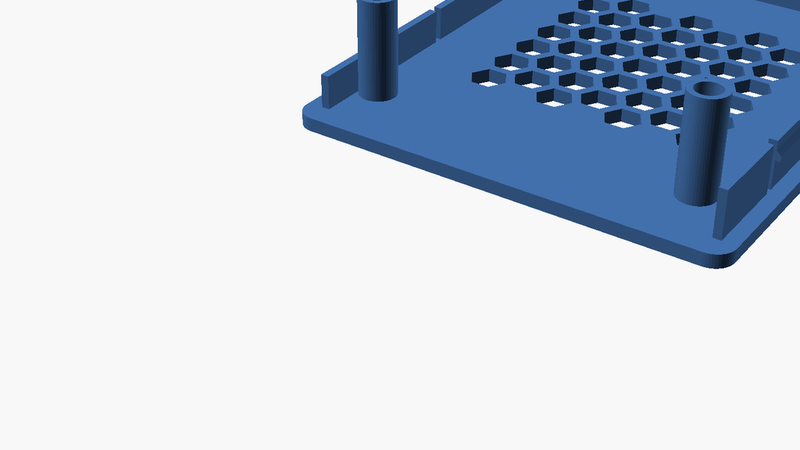
2. Lower the lid straight down. The lugs on the left and right ribs deflect inwards and snap into pockets in the cavity walls.
3. To open it again, slide a thin blade into either finger relief on the rear face and lift. To free the board, splay each barb with fine tweezers.
How it holds together
Board retention. The barb is Ø3.20 over a Ø2.70 hole, leaving a 0.25 mm retaining ledge — about 1.5 % bending strain on a 4.30 mm cantilever.
The seat and the spring are deliberately separate features. The board lands on a continuous, unsplit Ø4.00 → Ø5.50 ring, so it physically cannot sink past the seat however the peg behaves. An earlier revision combined the two and the board pushed straight through and sat 2.50 mm low.
Lid retention. Three lip ribs at independent depths — left, right and rear. The front rib is omitted entirely, because the RJ45 jacks leave only 1.64 mm below the rim there.
Make it your own
The `.scad` file is in the downloads. Open it in OpenSCAD and use Window → Customizer — every parameter becomes a slider or a checkbox.
| Parameter | Default | Effect |
|---|---|---|
| `HEADROOM` | 15.0 | Set 13.6 for a lower case if you do not need the tall 4-pin header |
| `gpio_slot` | false | Opens the lid over the 40-pin header |
| `soc_window` | false | Opens the floor so a heatsink can touch the SoC |
| `antenna_hole` | false | Ø6.5 SMA bulkhead in the rear wall |
| `fel_button_hole` | true | Paper-clip access to the UBOOT/FEL button |
| `sd_finger_notch` | true | Thumb relief for ejecting the microSD |
| `snap_pegs` | true | `false` gives plain interference pegs — kinder to PLA |
| `HEX_S` / `VENT_WALL` | 3.60 / 1.30 | Honeycomb cell size and the web between cells |
Re-export with:
openscad -o tray.stl -D 'part="tray"' -D 'show_board=false' cubie-a5e-case.scad
openscad -o lid.stl -D 'part="lid"' -D 'show_board=false' cubie-a5e-case.scad
Render with `part="preview"` and `show_board=true` first — that draws a translucent mock-up of the board and every connector inside the case, so you can check a port still lines up before committing a print.
Validation
Both parts were verified in software before release: watertight, single body, no self-intersections, and boolean-tested against a model of the PCB plus all 315 component envelopes from the STEP file — zero interference with either part, and zero between lid and tray when seated.
Several real defects were caught that way and fixed: a snap bead biting below the groove floor and holding the lid 0.76 mm off its seat, a Ø9 microSD thumb scallop that broke out through the bottom of the case (now Ø7), and a 0.50 mm web left between the left snap groove and the USB-A opening.
Then it was printed, and it assembled as designed.
Source, issues, full design notes
https://github.com/fshbet/radxa-cubie-a5e-case
The repository carries the complete measurement and validation record, including the coordinate transform used and the per-connector identification table. Issues and pull requests welcome — a photo of a print that does not fit is every bit as useful as a patch.
Not affiliated with or endorsed by Radxa. Verify fit against your own board revision before printing a full set.