L066H037 V0.1 LiPo Crash Protector Cage for drone frame

Description
Intro
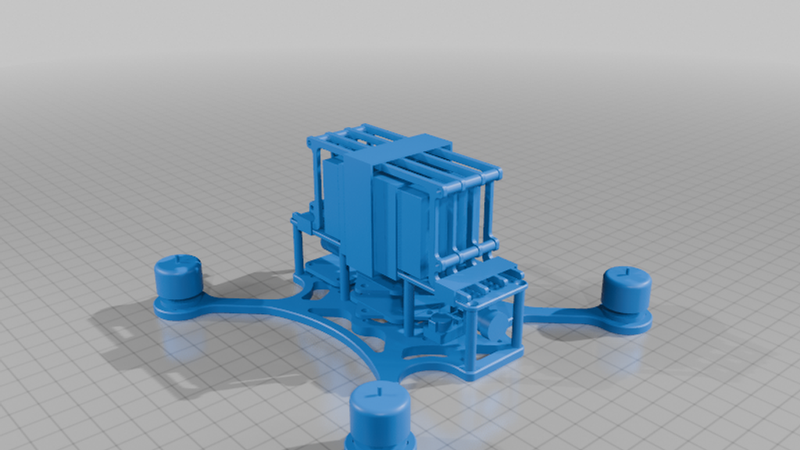
Name: Sugalime3D FPV L066H037 V0.1 LiPo Crash Protector Cage for drone frame
It can be used on the Mirro35 drone frame or almost any other 3-4" drone frame, though the arches (bows) might not be able to be spread quite as wide. The more rectangular the top plate is, the better, and the more securely and stable the cage sits on.
PURPOSE OF IT:
Reducing the risk of a LiPo damage and LiPo fire because of a drone crash.
It's actually questionable that so many people take the risk of their LiPo batteries being subjected to impacts from crashes. They're basically playing with the fire. Damaged LiPo batteries can catch fire later while charging or even spontaneously in storage. They endanger their own lives and the lives of others in the house building. The property is also at risk and therefore also financial risk as a result.
A burning LiPo battery can destroy your drone. Tell me, how do you safely remove a sparking LiPo from the drone ? And then, do you just leave the burning LiPo there because you can't put it in your backpack or car ? Leaving it behind is illegal and—depending on where it’s left—could start a forest fire...
Timeline
Check regularly for updates. More parts will likely be added if the tests are successful (TPU parts, carbon fiber parts, ...) !
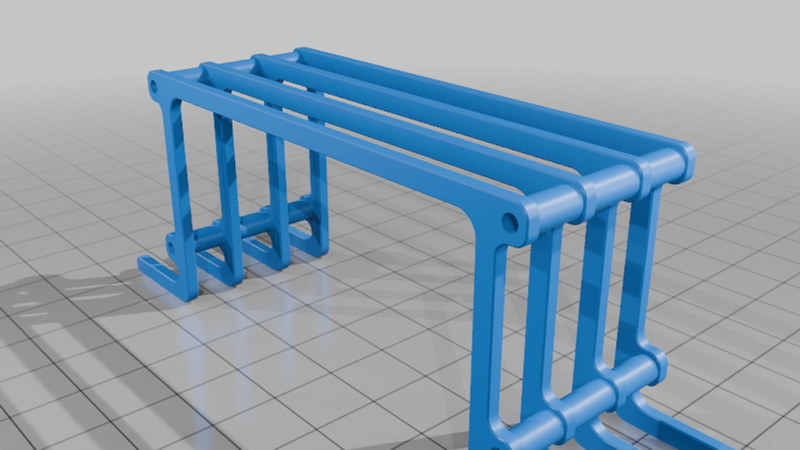
* July 1, 2026: Publication date: Starting with Bow; Bow NC; Assembly without side plates preview; Assembly WSP and Mirro35 drone frame preview
Selected posts from social media of this project (new to old)
https://www.tiktok.com/@sugalime3d_fpv/photo/7651990681170251030
https://www.tiktok.com/@sugalime3d_fpv/photo/7649392975356742934
https://www.tiktok.com/@sugalime3d_fpv/photo/7649114760083967254
https://www.tiktok.com/@sugalime3d_fpv/video/7643972052671646998
https://www.tiktok.com/@sugalime3d_fpv/video/7643669904998026518
https://www.tiktok.com/@sugalime3d_fpv/video/7624712236430298390
Specs
Compatible LiPo sizes:
LiPo battery with it's straps and the Lipo pad max dimensions is: 64 mm in length, 37 mm in height.
However, you also need to consider or select the right size so that the cables come out properly through the cable opening...
Compatible examples Year 2026 (No guarantee !):
* LiPo 4S 850 mAh for example in 60 x 32 x height 32 mm
* LiPo 4S 750 mAh for example in 60 x 31 x height 27 mm
* LiPo 4S 650 mAh for example in 61 x 31 x height 22 mm
Not compatible examples Year 2026 (No guarantee !):
* LiPo
CARBON FIBER THICKNESS:
The bows are 2,0 mm
The side plates are 1,0 mm
Available editions so far
Labels:
See descitption CNC service Chamfer editions for the detailed description of the labels
"OPCO" = Outer Perimeter Chamfered Only
"turned45XY" = Turned 45° on XY axis. Arms parallel to carbon fiber pattern.
"NC" = No chamfers
"NCS" = No countersinks
"" = Directors cut (Like the designer wishes it to be)
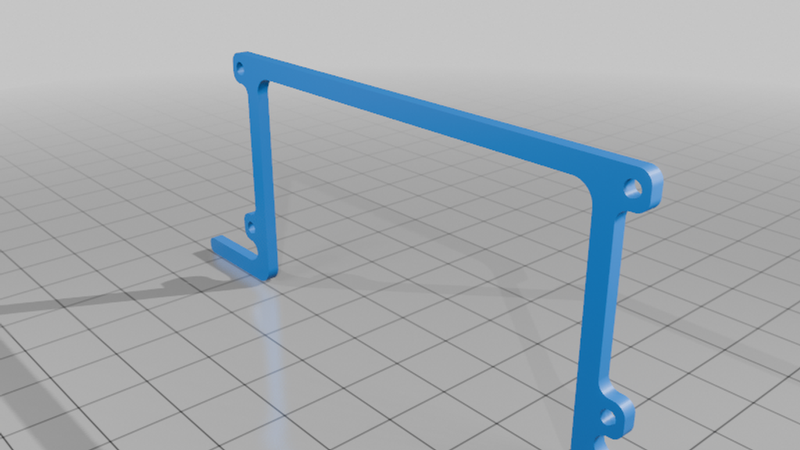
* Bow
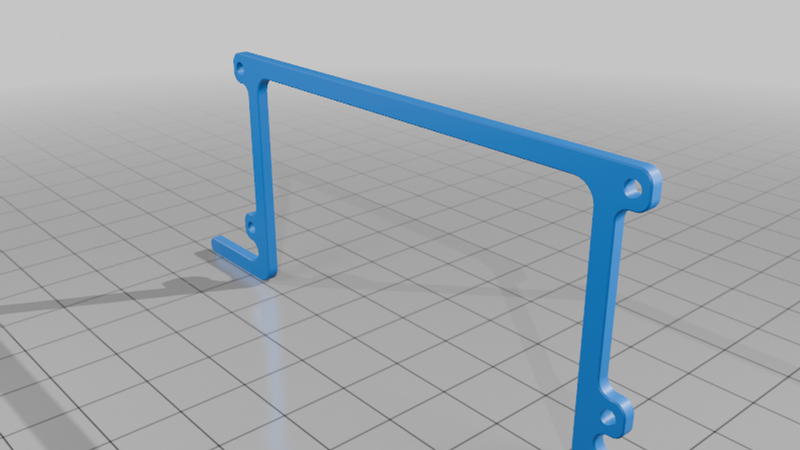
* Bow NC
More parts are comming soon (no guarantee !)
After the allready uploaded 0tilt edition top plate has been successfully tested, I will add more (no guarantee):
* Side plate non cable side
* Side plate cable side SLOW
* Side plate cable side FAST
Weight calculation (theoretically)
Bow (without chamfers) = cm^2
* 2,0 thick T-700 carbon fiber = g
Designed to international standards
Based on DIN EN ISO 7721 and ISO 10642. And close fit (not normal fit) with screws MX regular (not MX fine).
M3 screws ISO regular M3x0,5:
Screw Clearance M3 Holes: 3,20 mm (clearance close 3,2 not medium 3,4 mm)
M3 90° Countersink: 6.50 mm diameter (not the theoretical max of 6,94 mm)
(with FreeCAD PartDesign_Hole, ISO regular, clearance setting close/fine, results in 3,2 mm hole)
M2 screws ISO regular M2x0,4:
Screw Clearance M2 Holes: 2,20 mm (clearance close 2,2 not medium 2,4 mm)
M2 90° Countersink: 4,40 mm diameter
(with FreeCAD PartDesign_Hole, ISO regular, clearance setting close/fine, results in 2,2 mm hole)
M1.6 screws ISO regular M1.6x0.35:
Screw Clearance Holes: 1,70 mm (clearance close 1,7 not medium 1,8 mm)
M1.4 screws, ISO regular M1.4x0.3:
Screw Clearance Holes: 1,50 mm (clearance close 1,5 not medium 1,6 mm)
CNC SERVICE
You can give the CNC service the STEP files; it contains all the information, including details about the plate thickness and chamfers.
List of services
(No guarantee of legitimacy, these are all the ones I found, not the ones I tested.)
The frame is currently not listed on any of the stores, so you will need to request a quote.
* Made in Canada: CNC drones; CNC Madness; ...
* Made in China: CK-Carbon Fiber Store (Aliexpress store ID 1104334140 or search for 1005012382499688 (item)); FPVdroneframe dot com; PCB Way; ...
* Made in France: FPV CNC drone; ...
* Made in Germany: Ahltec (Inh. Angelika Leonhardt); CarbonForce® GmbH, Carbon Composite AG; CARBON-EXPRESS GmbH, Carbon-Posten und Modellbau (Inh. Sandra Schmidt); CG TEC Carbon und Glasfasertechnik GmbH; ...
* Made in Taiwan: Armattan Productions Co., Ltd; ...
Carbon fiber material international standards
Choose what you consider the best sweat spot for your purpose or choose T-800S if money is not a factor to be considered.
Tensile strength is the factor when it comes to arm breaking. Tensile modulus (stiffness) is the factor for vibrations and resonances that can be transmitted to the gyro.
* T-300: Tensile strength: ~ 3530 MPa. Tensile modulus (stiffness): ~ 230 GPa. The affordable and most used standard.
* T-700S: Tensile strength: ~ 4900 MPa. Tensile modulus (stiffness): ~ 235 GPa. Used on expensive high-quality premium frames.
* T-800S: Tensile strength: ~ 5685 MPa. Tensile modulus (stiffness): ~ 294 GPa. Consumer ready in the future. This aerospace and commercial aviation standard is becoming affordable for the consumer hobby market. By now, some very expensive premium drone frames actually use it.
Plate rotation for carbon fiber rectangle pattern matching arms
Should be good. It doesn't really matter that they're mostly right angles. The CNC manufacturer should normally position them correctly using this STEP files.
ADVICE FOR MYSELF THE DESIGNER (so i never foget in future project exports): In FreeCAD the STEP export has to be saved with "Export single object placement" otherwise it won't be rotated by 45° !
Filets
The fillets are always chosen to be as large as possible (better for durability) and never have a radius below 1.00 mm (standard milling heads have a minimum limit).
The smallest fillet radius used in this project:
Outer corner: 1,25 mm
Inner corner: 1,75 mm (i.e., it can be milled with a D3,5 CNC).
Chamfer editions & Edition labels
The chamfers are important to prevent the electric cables, the LiPo straps or your fingers skin from being cut.
There are 4 editions:
* NC NCS: Edition is without chamfers and without countersinks. Requires the least milling work. Advantage: The cheapest option.
* NC: Edition is without chamfers (NC = No chamfers) Advantage: The second cheapest option.
* OPCO: Edition is with "Outer Perimeter Chamfered Only". Requires often only a bit more milling work using a buck side chamfer mill.
* NORMAL (Non labeled): It is the designer's version "Director's cut" . Like the designer wishes it to be. Version includes maximum of meaningful chamfers. Disadvantage: A part with a lot of chamfers on both sides can be very expensive especially when holes or radii are small, depending on the capabilities of the CNC manufacturer. The effort and time involved in the milling process can increase significantly. Consequently price can be 2-3x higher than that of the NC NCS version.
Buck side chamfer CNC process
The CNC service typically creates the double sided chamfer using a special drill head (buck side chamfering) that first makes the chamfer on top then on the bottom, or they use a high accuracy plate turning process if the holes are too small for the special drill.
Public example of buck side chamfering
https://www.youtube.com/shorts/9M66unswJ7c
Creating round edges without chamfer milling
The sharp corners can also be rounded off without milling chamfers: They place the part in a in a tumbling drum and they use a sharpening stones tumble vibratory deburring method, or they use other methods to remove the corners sharpness. However, the corners aren't rounded off as much with this method—especially if the manufacturer does not give it a lot of time to it. The edges remain relatively sharp and it doesn't match the quality and smoothness of chamfer milling. COSTS: Sometimes rounding the corners like this is cheaper, sometimes milling the chamfers is cheaper—it depends.
DEVELOPMENT FUTURE
Planned changes for the next version:
* No
DEVELOPMENT HISTORY
PREVIEWS VERSIONS:
GUARANTEE
This version is the first version i will order at a CNC service. Use at your own risk ! It is in version 0.1 and not 1.0 ! I guess it should work. However, it has not been tested yet. Big and/or small errors are possible. The design is still in the prototype phase. I have not ordered and tested the part through a CNC service yet. Therefore, the part may still be revised and then appear as V0.5 on a new page. Maybe tests will be successful and this will be the final version of the Mirro35 drone frame.
COPYRIGHT & CREDITS
PRIVATE USE:
You are allowed to download and copy and modify the frame for private use and upload and publish a CAD mod/remix with credits (My name and the link to this one); please note the license terms specified below. For non-commercial purposes, i.e., hobby videos or picture in the internet, me or the name of the frame I don't expect to be mentioned in videos or pictures or description. However, I appreciate it if you mention the name of the frame and the designer in the vid/pic itself or description.
COMMERCIAL USE:
I permit to download and use and copy and modify for commercial sales. However, I expect the designer name and product name to be mentioned in the title or description of the product with the product name: "L066H037 LiPo Crash Protector" and the designer name :"Sugalime3D FPV" or "Sugalime3D FPV design" or "designed by Sugalime3D FPV".
Examples:
[Your Brand] Sugalime3D FPV L066H037 LiPo Crash Protector
[Your Brand] L066H037 LiPo Crash Protector Sugalime3D FPV design