
Bio-Inspired Tendon-Driven Robotic Hand (Underactuated & Parametric)

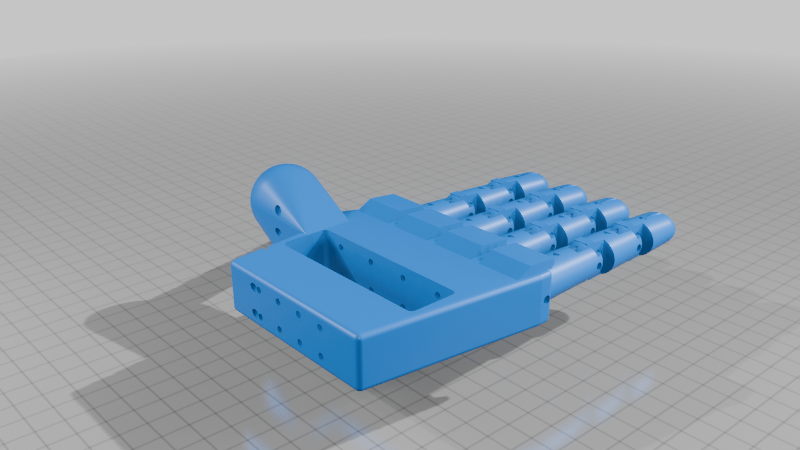
Description
Bio-Inspired Tendon-Driven Robotic Hand (Underactuated & Parametric)
This is a high-performance, bio-inspired robotic hand designed for researchers, hobbyists, and prosthetic developers. Inspired by the sophisticated musculoskeletal structure of the human hand, this design prioritizes dexterity, durability, and affordability.
The hand utilizes a tendon-driven actuation system, mimicking how forearm muscles transmit force through tendons to move biological joints. It features an underactuated design, meaning 15 kinematic degrees of freedom are controlled by only 5 actuators. This allows the fingers to mechanically "conform" and wrap around objects of various shapes without complex sensors or inverse kinematics.
Key Engineering Innovations
* Flared Tendon Channels: Conical "trumpet" geometry (14° transition) reduces friction and contact stress on cables by 8x, significantly extending the life of your tendon lines.
* Mechanical Hyperextension Stops: Integrated ridges prevent joints from "flopping" backward, maintaining control stability during extension.
* Parametric OpenSCAD Workflow: The entire model is driven by global variables. Need a smaller child-sized hand or a larger one? Change a single line of code in the provided `.scad` file to resize the geometry instantly.
* Optimized for FDM Printing: All parts are designed to be printed flat on the bed. This aligns the filament strands with the primary load path, preventing the delamination common in vertical 3D prints.
* Dual-Channel Antagonistic Control: Features both Dorsal and Volar channels for active flexion and extension, providing precise bidirectional control.
Applications
1. Affordable Prosthetics: A functional alternative to expensive commercial myoelectric hands. Total Bill of Materials is approximately £200 compared to £25,000+ systems.
2. Teleoperation: Ideal for hazardous material handling using a master-slave configuration with a data glove.
3. Research: A robust platform for testing EMG control, neural networks, and adaptive grasping.
Bill of Materials (BOM)
| Category | Item | Quantity | Purpose |
| :--- | :--- | :--- | :--- |
| 3D Parts | PLA or PETG Filament | ~150g | Printing the palm and fingers. |
| Actuators | MG996R Servo Motors | 5 | High-torque (10kg/cm) drivers. |
| Tendons | Dyneema or Fishing Line | 1 Spool | High-modulus fiber for actuation. |
| Fasteners | M3 Bolts | As needed | Standard pivot pins for joints. |
| Control | EMG Sensors/Arduino | 1 Set | Optional for gesture-based control. |
Assembly Instructions
1. Printing the Components
* Orientation: Ensure all phalanges are printed flat (rotated -90°). The provided OpenSCAD script includes logic to handle this automatically.
* Tolerance: The design includes a 0.5mm parametric gap in the tongue-and-groove joints to ensure smooth movement straight off the printer.
2. Joint Assembly
* Modular Chains: Assemble the fingers using the standard segments (Proximal: 35mm, Medial: 25mm, Distal: 22mm).
* Mechanical Stops: When joining segments, ensure the interference ridges on the dorsal side are aligned to prevent hyperextension.
* Pivot Pins: Insert M3 bolts through the joint holes. For rapid prototyping, pieces of 3D printing filament can be used as pins.
3. Tendon Routing
* Dual Channels: Route two lines through each finger—one through the Dorsal channel for extension and one through the Volar channel for flexion.
* Friction Reduction: Ensure the tendons pass through the flared entries to minimize fraying.
* Palm Hub: Guide all 10 tendons through the internal palm pathways toward the wrist exit.
4. Actuation Setup
* Dual-Spool Pulley: Connect each finger's two tendons to a single MG996R motor using a dual-spool pulley. This enables active "pull-pull" control.
* Underactuation: Note that a single motor drives all three joints of a finger simultaneously; the joint with the least resistance moves first.
Troubleshooting & Limitations
* Grip Force: The estimated grip force is approximately 10N. This is suitable for light tasks but may fall short for heavy-duty lifting compared to commercial benchmarks.
* Sensory Feedback: This version is open-loop and lacks native haptic or force sensors.
* Friction: While flared channels reduce wear, tendon friction still consumes a portion of the servo's stall torque.
* Compliance: Tendon systems are inherently compliant; if the hand accidentally impacts an object, the tendons may slacken or stretch to prevent damage.
SEO Tags / Keywords
`Robotic Hand` `Bionic Hand` `Prosthetic` `OpenSCAD` `Tendon-Driven` `Bio-inspired` `Underactuated` `Robotics` `3D Printed Hand` `Anthropomorphic` `EMG Control` `Parametric Design` `Cybernetics` `DIY Prosthetic` `Mechanical Hand`